
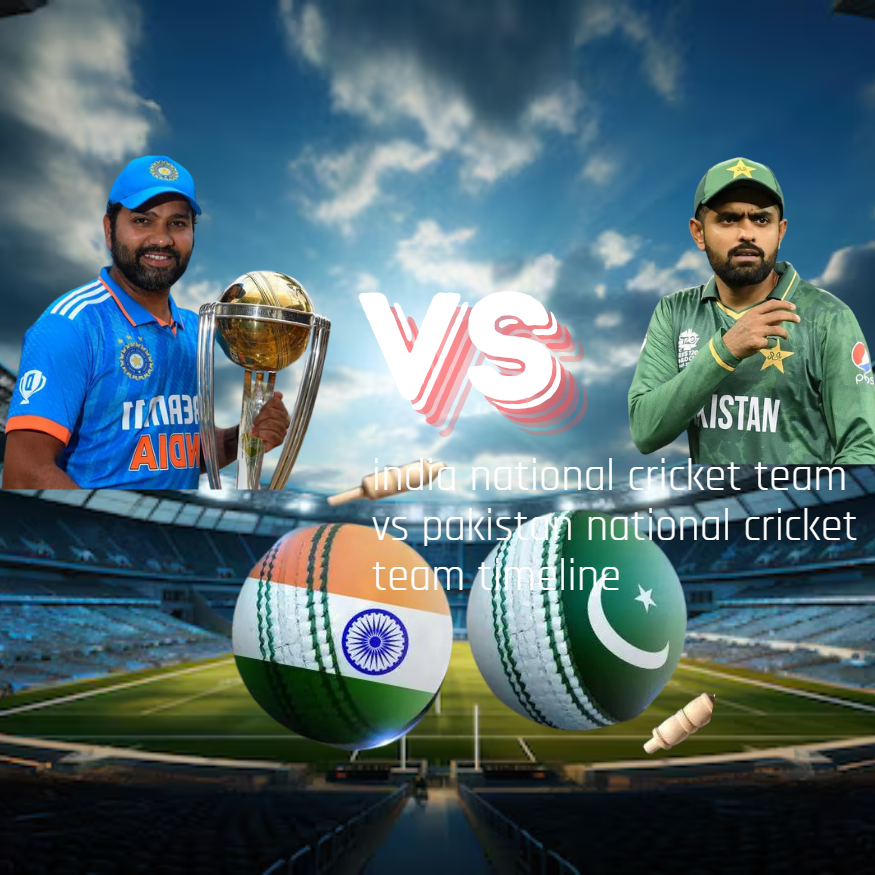

The cricket rivalry between India and Pakistan is legendary, combining high-stakes performances, national pride, and intense emotions. This isn’t just about sport—it’s a narrative interwoven with historical, political, and social threads. Here’s a detailed look at how this cricketing rivalry has evolved over the decades.
Origins of the India-Pakistan Cricket Rivalry
The roots of the rivalry trace back to the partition of British India in 1947. After becoming two separate nations, India and Pakistan didn’t just become political adversaries; their sports engagements also took on greater significance. Cricket, being a widely popular sport in both countries, quickly became an arena for proving supremacy, with the first official cricketing encounter coming in 1952.
First Encounter – 1952: The Dawn of a Rivalry
In 1952, Pakistan visited India for their first Test series, marking the beginning of this intense cricketing competition. India emerged victorious in that series, winning 2-1. This set the tone for future encounters, with every match gaining more significance over time as a demonstration of national prowess on both sides.
1950s-70s: The Rivalry in its Early Stages
Throughout the 1950s, 60s, and 70s, the India-Pakistan cricket rivalry was more formal than fierce. While the matches were competitive, they lacked the high voltage energy seen in later years. Key players like India’s Vinoo Mankad and Pakistan’s Hanif Mohammad brought style and substance to these encounters, ensuring the rivalry would steadily build.
The 1980s: Cricket Becomes a National Obsession
The 1980s heralded a new phase in the India-Pakistan cricket rivalry, as both teams started becoming cricket powerhouses. Television coverage expanded, and for the first time, fans from both nations could watch these matches live, adding to the intensity. Stadiums packed with vocal supporters made every match feel like a final.
1986 Austral-Asia Cup – Javed Miandad’s Last Ball Six
One of the most iconic moments of the 1980s was Javed Miandad’s last-ball six in the 1986 Austral-Asia Cup final. Pakistan needed four runs off the last ball to win, and Miandad sent the ball soaring into the stands. That moment became one of the most talked-about events in Indo-Pak cricket history, further inflaming the rivalry.
Sharjah Showdowns: The Neutral Battleground
During the late 1980s, matches between India and Pakistan often took place in Sharjah, United Arab Emirates—a neutral venue. These games were often tense, with both teams evenly matched, and players like Kapil Dev, Imran Khan, Sunil Gavaskar, and Wasim Akram battling it out in thrilling encounters.
The 1990s: Political Tensions Spill Over
By the 1990s, the rivalry between India and Pakistan had transcended cricket, becoming deeply interwoven with political tensions. Matches became a battleground of sorts, with players representing more than just their teams—they were playing for national pride. This decade also marked the rise of legends like Sachin Tendulkar and Wasim Akram, further intensifying the competition.
1996 World Cup Quarterfinal – Bangalore’s Electrifying Night
The 1996 World Cup quarterfinal between India and Pakistan was one of the most unforgettable matches in the history of this rivalry. Held in Bangalore, India, it was a high-voltage encounter that saw India claim victory by 39 runs, thanks to Navjot Singh Sidhu’s explosive performance. The atmosphere was charged with national fervor, and this match still stands as one of the most talked-about encounters.
The 2000s: A New Format, Same Rivalry
As cricket evolved into new formats, so did the India-Pakistan rivalry. With the introduction of T20 cricket and a growing focus on ICC tournaments, every encounter between these two teams became a media spectacle. High viewership numbers and packed stadiums greeted every India-Pakistan match, regardless of the venue.
2007 T20 World Cup Final – A Historic Encounter
India and Pakistan faced off in the inaugural T20 World Cup final in 2007. The match ended with India clinching the title in dramatic fashion. Misbah-ul-Haq’s mistimed scoop, which led to his dismissal, handed India the trophy, but it also demonstrated how closely contested matches between these two nations had become.
2010s and Beyond: Fewer Matches, Bigger Impact
Due to political tensions, bilateral cricket series between India and Pakistan have been rare in recent years. However, the teams continue to face each other in ICC events like the World Cup and Asia Cup, and these encounters are always highly anticipated. Despite the limited number of matches, the intensity remains unmatched.
2017 ICC Champions Trophy – Pakistan’s Sweet Revenge
The 2017 ICC Champions Trophy final was one of Pakistan’s finest moments in modern cricket. After being considered underdogs, Pakistan demolished India by 180 runs, with Fakhar Zaman’s century leading the charge. This victory was seen as redemption for Pakistan after years of being bested by their arch-rivals.
Cricket as a Unifying Force Amidst Political Tensions
Despite the strained political relationship between India and Pakistan, cricket often acts as a bridge. Matches between the two nations bring people together, with fans from both countries sharing the same love for the sport, even if the emotions are polarized. Although the rivalry is fierce, it also represents hope for future cooperation and unity through sports.
Conclusion: A Rivalry Beyond Boundaries
The India-Pakistan cricket rivalry is more than just a sporting event; it is an emotional, cultural, and political spectacle. It has seen legends born, nations divided, and millions of fans united in passion. Despite the infrequency of bilateral series, every match remains monumental, and the story of this rivalry continues to evolve with every new generation of cricketers.
FAQs
1. When did the India-Pakistan cricket rivalry begin?
The rivalry began in 1952, with Pakistan’s first official Test series against India.
2. Why is the India-Pakistan cricket rivalry so intense?
The rivalry stems from historical, political, and social factors that have heightened the significance of each cricket match between these two nations.
3. How often do India and Pakistan play against each other?
Due to political tensions, bilateral series are rare. They primarily face off in ICC tournaments and regional competitions like the Asia Cup.
4. What was the result of the 2007 T20 World Cup final?
India won the 2007 T20 World Cup final against Pakistan by 5 runs, making it one of the most iconic matches in T20 history.
5. What was Pakistan’s biggest win against India?
One of Pakistan’s biggest wins came in the 2017 ICC Champions Trophy final, where they defeated India by 180 runs.